
From the Frontlines of Research and Studies [USA]: SAIGO Taichi
The National Institutes for the Humanities (NIHU) sends young scholars, who are participants in Institute-based projects and co-creation initiatives, to international seminars and research institutions abroad, including universities. This program aims to promote NIHU’s projects and support young scholars in their academic studies, presentations at international seminars, and other overseas research opportunities.
In this issue, we feature a report from SAIGO Taichi of the Graduate University for Advanced Studies (Sokendai) , who was dispatched to USA.
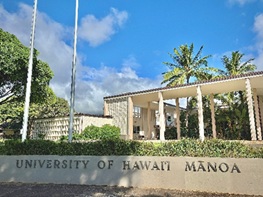
I participated in the NIHU Overseas Visit Program for Young Researchers, during which I stayed at the University of Hawaiʻi at Mānoa (UHM) in the United States and conducted research on language documentation to preserve minority languages. UHM is one of the leading international centers for research on endangered language preservation.

I am involved in documenting the Niijima dialect, spoken on Niijima Island, one of several small islands administered by the Tokyo metropolitan government. In Japan, while there is a strong tradition of regional dialect research centered on grammatical analysis, documentation aimed specifically at the preservation of linguistic materials has yet to be fully established as a distinct field of study. My objectives for this visit were to share the current state of endangered language research in Japan with researchers at UHM, exchange information, and learn advanced research methods.
In contemporary language documentation research, it is widely recognized that not only researchers but also members of the communities who use the language in their daily lives should serve as principal practitioners of documentation and preservation. In line with this global trend, UHM’s Language Documentation Training Center (LDTC), an organization run primarily by students, is designed to train and support community members as practitioners of documentation. The LDTC conducts a range of ongoing activities aimed at preserving languages for future generations. During my stay, a workshop was held in which several speakers of Oceanic languages created stop-motion animations based on local legends and folktales. I also participated in the video production process.
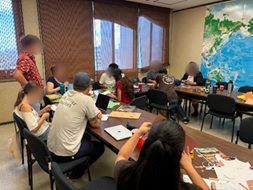
In addition, I had the opportunity to present my research at the Sixth Chuo–UHM–UTokyo Student Conference on Linguistics, Psycholinguistics and Second Language Acquisition, jointly organized by UHM, Chuo University, and the University of Tokyo. I also presented at the Tuesday Seminar, a regular seminar series at UHM. On both occasions, I received a number of constructive comments from participants.
Through these experiences, I gained a firsthand understanding of the importance of community-based documentation, as well as insights that can help advance language documentation as a recognized research field in Japan.
Saigō Taichi
Doctoral Student, the Graduate University for Advanced Studies (Sokendai).
Saigō specializes in Japanese linguistics and research on the documentation and preservation of minority languages. He works with local residents on Niijima Island, which is part of metropolitan Tokyo, to document the local dialect and ensure its preservation for future generations.