
Social Collaboration Project with Liberal Arts Communicators
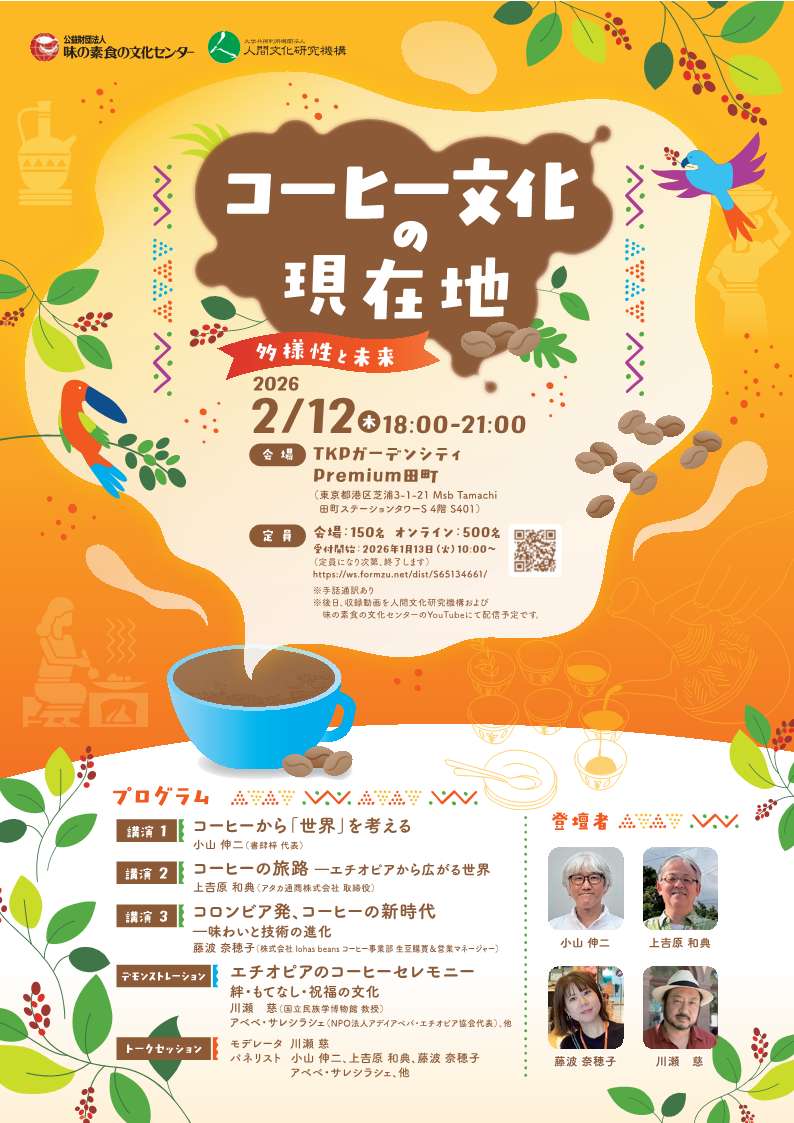
The National Institutes for the Humanities (NIHU) and the Ajinomoto Foundation for Dietary Culture have been organizing symposiums on food and culinary culture since 2018, sharing these events through NIHU’s official YouTube channel and NIHU Magazine. This issue of NIHU Magazine offers a behind-the-scenes look at the planning stage of a symposium in which liberal arts communicators worked together with the Ajinomoto Foundation for Dietary Culture.
Social Collaboration Project with Liberal Arts Communicators
NIHU’ training program for early career doctoral researchers in the humanities—known as liberal arts communicators—entered its ninth year in 2025. Looking back on previous program activities, participants have been involved in planning and managing joint events with science communicators from institutions such as the National Museum of Nature and Science and the National Museum of Emerging Science and Innovation (Miraikan). Other activities have included museum-based training at institutions such as the National Museum of Ethnology and the National Museum of Japanese History, as well as at the Printing Museum, Tokyo, where participants worked on the commentaries for items in their host institutions’ collections.
In contrast to previous program activities, in 2025 participants engaged in social collaboration through the planning of a jointly hosted symposium organized by NIHU and the Ajinomoto Foundation for Dietary Culture. Planning the symposium dedicated to food culture involved defining the specific theme, as well as choosing appropriate speakers. Speakers included not only researchers based in Japan from the NIHU-related and other institutes, but individuals such as specialists in culinary research and representatives of food manufacturers closely related to the topic. The six liberal arts communicators listed below were invited to participate in the project in anticipation of their ability to draw on both their respective academic research networks and the professional connections they have developed within their host inter-university research institutions.
• NURADI Raditya (Assistant Professor, National Museum of Japanese History)
• KAWATA Shōko (Assistant Professor, National Institute of Japanese Literature)
• YOKOYAMA Akiko (Assistant Professor, National Institute for Japanese Language and Linguistics)
• KOMAI Sachi (Assistant Professor, International Research Center for Japanese Studies)
• SAWAZAKI Kenichi (Assistant Professor, Research Institute for Humanity and Nature)
• KUDŌ Sakura (Assistant Professor, National Museum of Ethnology)
*Individual names and host institutions reflect information current as of the first half of 2025.
In May of 2025, an initial online meeting was held with the Ajinomoto Foundation for Dietary Culture, serving both as an opportunity for participants to get acquainted and for initial discussion about the symposium. During the meeting, participants exchanged views based on a set of themes proposed by the liberal arts communicators. The proposed themes are outlined below.
• Komai: Theme selection based on the survey results from last year’s symposium (e.g., Japanese sake, umami)
• Yokoyama: Sweets, especially various types of gummies
• Sawazaki: African domestic food practices and dining etiquette as portrayed in visual media
• Kawata: Eating practices and dining etiquette depicted in the Edo-period printed materials
After the meeting, the liberal arts communicators met to review the discussion and narrowed the proposals down to the following two in preparation for the June meeting:
• Proposal 1: Dining etiquette and eating practices
• Proposal 2: Japanese sake
They also discussed potential candidates for moderator—a central figure among the speakers—as well as the symposium’s target audience.
At the second meeting with the Ajinomoto Foundation for Dietary Culture in June, the participants discussed the Proposals 1 and 2 and refined Proposal 1 to focus on Etiopian coffee ceremonies and tea-making procedures and rituals in Asia, including Japanese chanoyu tea gatherings.
Subsequently, with Kudō taking the lead, the theme was explored in greater depth. Through internal discussions involving other liberal arts communicators and NIHU Executive Director KURIMOTO Eisei, it was decided to make “coffee” the main theme. The group went on to discuss possible perspectives on the theme, as well as potential candidates for moderator.
• Yokoyama: “Coffee” may be used as a loanword, but how is it changed in recipient cultures?
• Kurimoto: Colonialism and slavery in relation to coffee
• Sawazaki: Coffee and cigarettes as a paired motif in the film Coffee and Cigarettes
• Komai: Social customs and coffee (aimed at a broad audience, including younger generations)
• Kawata: How about inviting a barista as a speaker?
• Nuradi: Food products, including coffee, are closely linked to trade
• Kudō: Differences of coffee culture in West and East Africa. Why don’t we use Min-Pack, MINPAKU’s learning kit rented to schools and other educational institutions to experiential lectures?
At the third meeting with the Ajinomoto Foundation for Dietary Culture in July, “coffee” was confirmed as the theme and the participants discussed the speaker lineup, including the moderator.
Subsequently, Kudō approached Professor KAWASE Itsushi of the National Museum of Ethnology to serve as the moderator. Upon receiving his acceptance, a fourth meeting was held in August with Professor Kawase in attendance.
Professor KAWASE spoke about the Ethiopian coffee ceremony in eastern Africa, which he has studied through his field, as well as the community life of Ethiopians in Japan, particularly those based in Katsushika Ward, Tokyo. He also introduced potential speakers, and through these discussions the outline of the joint symposium gradually took shape.
At an October meeting with the Ajinomoto Foundation for Dietary Culture, the theme, full lineup of speakers, and overall structure of the jointly hosted symposium were finalized, and plans were set in motion to hold the event.
We sincerely look forward to your participation.
Text: OHBA Go, Research Fellow, the Center for Innovative Research, the National Institutes for the Humanities
* In preparing this article, reference was made to the minutes and other records from meetings held to date with the Ajinomoto Foundation for Dietary Culture. Sincere thanks to Kawata Shōko, who was responsible for preparing the meeting minutes.